Bahrain: Country Profile and Government Structure
Introduction
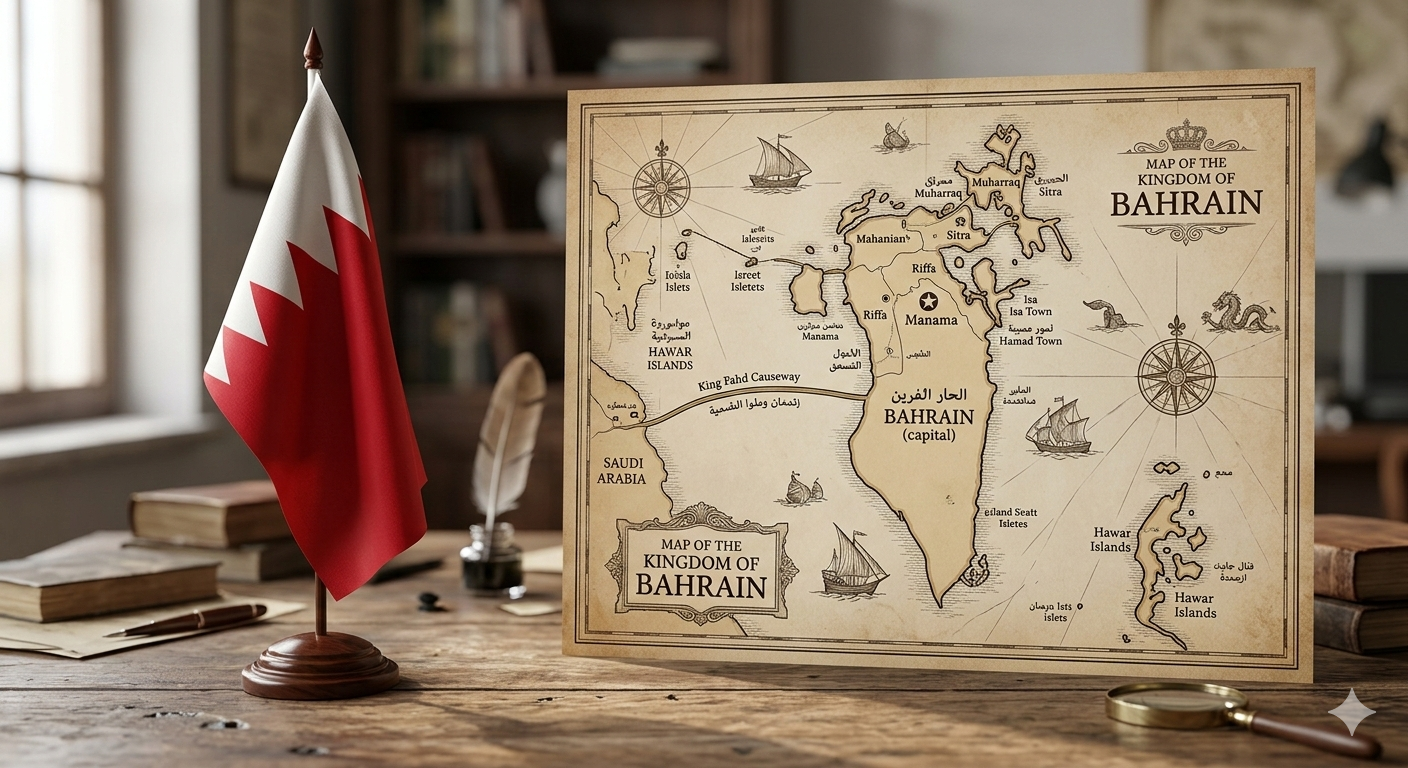
Bahrain is an island nation in the Arabian Gulf, located between Saudi Arabia and Qatar. Comprising more than 30 islands, Bahrain has historically served as a regional trade and financial hub. The country operates as a constitutional monarchy and plays an active role in Gulf political and economic affairs. Its strategic location and diversified economy distinguish it among Gulf Cooperation Council (GCC) states.
Geography and Demographics
Bahrain covers approximately 760 square kilometers, making it one of the smallest countries in Asia. The capital city, Manama, functions as the political, commercial, and financial center of the country.
Arabic is the official language and Islam is the state religion. The population consists of Bahraini citizens and a significant expatriate workforce. Both Sunni and Shia Muslim communities form part of the social fabric, alongside smaller religious minorities.
Historical Background
Bahrain has a long history dating back to the ancient Dilmun civilization. In the 19th century, it became a British protectorate. Full independence was declared on 15 August 1971.
In 2002, Bahrain adopted a new constitution and formally transitioned from an emirate to a kingdom under the leadership of the Al Khalifa family. Political reforms during this period introduced a bicameral legislative system.
Political System and Government Structure
Bahrain is a constitutional monarchy governed under the Constitution of Bahrain.
The King
The head of state is the King, currently from the Al Khalifa ruling family. The King holds executive authority, appoints the Prime Minister and cabinet members, and has the power to dissolve the lower house of parliament. The monarchy plays a central role in national governance and foreign policy.
The Executive Branch
The executive authority is exercised by the Council of Ministers, headed by the Prime Minister. The cabinet is appointed by royal decree and is responsible for implementing state policies, managing public administration, and drafting legislation.
The Legislative Branch
Bahrain has a bicameral legislature known as the National Assembly of Bahrain, consisting of:
- The Council of Representatives (lower house), whose 40 members are elected by popular vote.
- The Shura Council (upper house), whose 40 members are appointed by the King.
Both chambers participate in reviewing and approving legislation. However, appointed members of the Shura Council balance the elected lower house within the legislative process.
The Judiciary
The judiciary in Bahrain is constitutionally independent. It comprises civil, criminal, and Sharia courts. The legal framework blends Islamic law with elements of civil law traditions. The Court of Cassation serves as the highest judicial authority.
Economy
Bahrain was the first Gulf country to discover oil in 1932. Although oil remains important, Bahrain has diversified its economy into banking, finance, tourism, and aluminum production.
The country is recognized as a regional financial center, with a strong Islamic banking sector. Bahrain is also a member of the Organization of the Petroleum Exporting Countries (OPEC) and the Gulf Cooperation Council (GCC), strengthening its regional economic integration.
Foreign Policy and International Relations
Bahrain maintains close relations with GCC member states and Western allies. It hosts the United States Navy’s Fifth Fleet, reflecting its strategic military importance. Bahrain actively participates in regional security initiatives and international economic cooperation.
Social Development and Infrastructure
The government has invested in education, healthcare, housing, and public services. Bahrain maintains modern infrastructure, including transportation networks and digital governance initiatives. Social reforms and economic modernization remain ongoing priorities.
Conclusion
Bahrain represents a constitutional monarchy combining traditional leadership with structured legislative institutions. Its 2002 constitutional reforms marked an important shift toward parliamentary governance within a monarchical framework. As a small yet strategically positioned Gulf state, Bahrain continues to balance economic diversification, political reform, and regional diplomacy.
References
- Government of Bahrain. (n.d.). National Portal of the Kingdom of Bahrain.
https://www.bahrain.bh - Constitution of the Kingdom of Bahrain. (2002). Government of Bahrain.
- World Bank. (2023). Bahrain Overview.
https://www.worldbank.org/en/country/bahrain - Organization of the Petroleum Exporting Countries (OPEC). (n.d.). Member Country Profile: Bahrain.
https://www.opec.org - Gulf Cooperation Council (GCC). (n.d.). Member States.
https://www.gcc-sg.org
Last updated on 03 March 2026 at 11:45 PM.