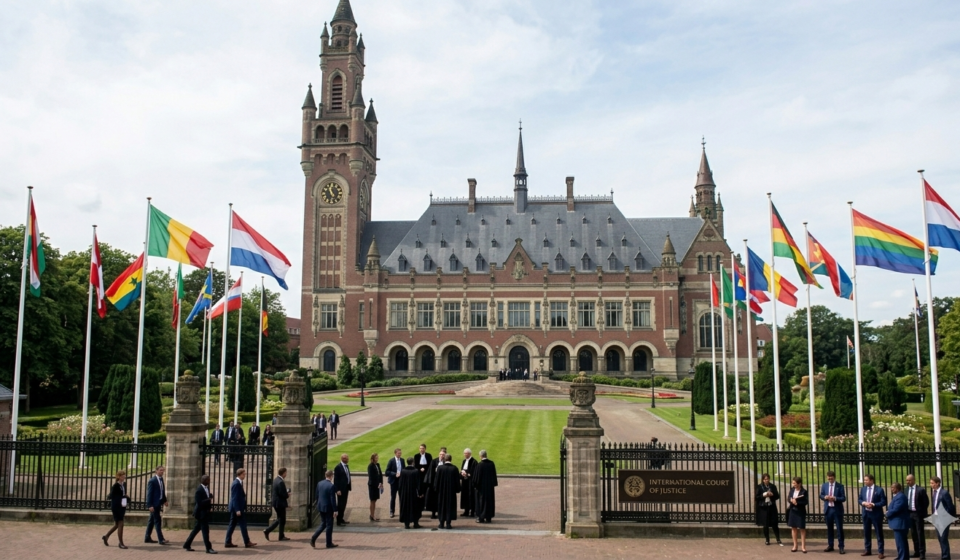
International Court of Justice (ICJ): Structure, Jurisdiction and Global Role
Introduction
The International Court of Justice (ICJ) is the principal judicial organ of the United Nations. Established in 1945 under the Charter of the United Nations, the ICJ began its work in 1946. It is headquartered at the Peace Palace in The Hague, Netherlands.
The Court’s primary function is to settle legal disputes submitted by states and to provide advisory opinions on legal questions referred to it by authorized UN organs and specialized agencies. As the only international court with universal jurisdiction between states, the ICJ plays a central role in the peaceful settlement of disputes under international law.
Historical Background
The ICJ succeeded the Permanent Court of International Justice (PCIJ), which operated under the League of Nations from 1922 to 1946. After World War II, the newly formed United Nations established the ICJ as part of its institutional framework.
The Court operates under its Statute, which forms an integral part of the UN Charter. All UN member states are automatically parties to the Statute of the ICJ.
Structure and Composition
The Court consists of 15 judges elected for nine-year terms by the UN General Assembly and the UN Security Council, voting independently but concurrently. Judges must represent the principal legal systems of the world and are elected regardless of nationality, although no two judges may be nationals of the same state.
Judges may be re-elected and must act independently, not as representatives of their governments. The Court elects its President and Vice-President for three-year terms. The Registrar oversees administrative functions.
Jurisdiction and Functions
The ICJ exercises two main types of jurisdiction:
Contentious Jurisdiction
The Court settles legal disputes between states that consent to its jurisdiction. These disputes may involve territorial boundaries, maritime delimitation, diplomatic relations, treaty interpretation, and state responsibility. Only states may be parties in contentious cases; individuals and organizations cannot directly bring cases before the Court.
Advisory Jurisdiction
The ICJ provides advisory opinions on legal questions referred to it by authorized UN bodies, such as the General Assembly and the Security Council. Although advisory opinions are not legally binding, they carry significant legal authority and influence international law development.
Sources of Law Applied by the ICJ
Under Article 38 of the ICJ Statute, the Court applies:
- International conventions and treaties
- International custom as evidence of general practice
- General principles of law recognized by civilized nations
- Judicial decisions and scholarly writings as subsidiary means
This framework establishes the ICJ as a key interpreter and developer of international law.
Relationship with the United Nations
The ICJ is one of the six principal organs of the United Nations. While independent in its judicial functions, it reports annually to the UN General Assembly. The Security Council may enforce ICJ judgments if a party fails to comply, although such enforcement depends on political considerations.
Role in International Dispute Resolution
The Court contributes to global stability by providing a peaceful mechanism for resolving interstate disputes. It has adjudicated cases involving territorial sovereignty, environmental issues, human rights obligations, and maritime boundaries.
Through its judgments and advisory opinions, the ICJ has shaped interpretations of international law, including principles such as non-use of force, state responsibility, and self-determination.
Limitations and Criticism
The ICJ’s jurisdiction depends on state consent, which can limit its effectiveness. States may choose not to accept compulsory jurisdiction or may withdraw declarations recognizing it. Additionally, enforcement of decisions relies largely on voluntary compliance or Security Council action.
Despite these limitations, the ICJ remains a central institution in the international legal system.
Conclusion
The International Court of Justice serves as the primary judicial forum for resolving disputes between sovereign states under international law. Established under the United Nations framework, it promotes peaceful conflict resolution and legal clarity in global governance. While dependent on state cooperation, the Court’s decisions and advisory opinions significantly influence the development of international law and the maintenance of international peace and security.
References
- United Nations. (1945). Charter of the United Nations.
https://www.un.org/en/about-us/un-charter - International Court of Justice. (n.d.). Official Website.
https://www.icj-cij.org - Statute of the International Court of Justice. (1945). United Nations.
- United Nations General Assembly. (n.d.). Role of the ICJ.
https://www.un.org - Shaw, M. N. (2017). International Law. Cambridge University Press.
Last updated on 05 March 2026 at 04:25 AM.