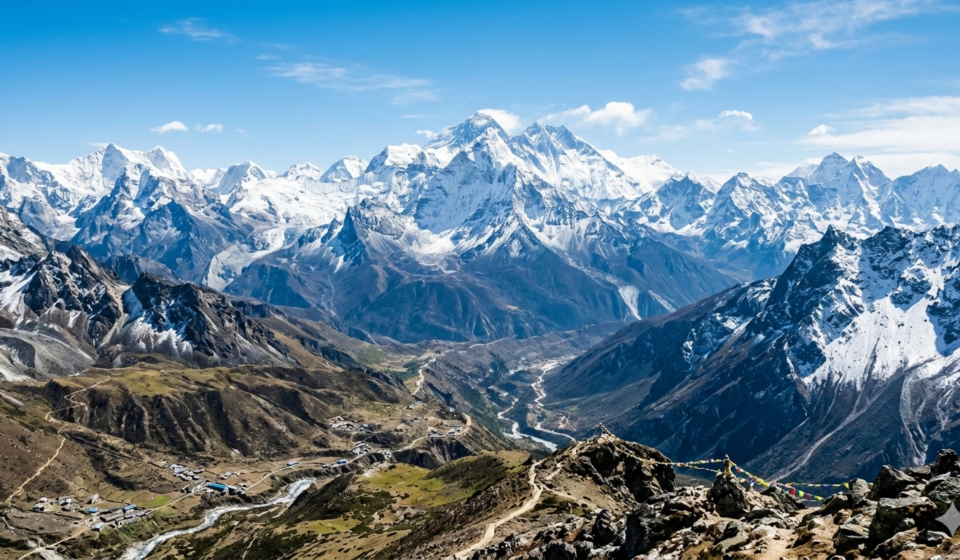
Himalayan Mountains: Geography, Ecology, and Regional Significance
The Himalayas are the highest and one of the youngest mountain ranges in the world, stretching across South and Central Asia. The range extends approximately 2,400 kilometers through India, Nepal, Bhutan, China (Tibet Autonomous Region), and Pakistan.
The Himalayas contain the world’s highest peak, Mount Everest, which rises to 8,848.86 meters above sea level. The mountain system plays a crucial role in regional climate regulation, biodiversity conservation, and water resources for nearly two billion people.
Geological Formation
The Himalayas were formed approximately 50 million years ago due to the collision between the Indian Plate and the Eurasian Plate. This tectonic convergence continues today, causing the mountains to rise gradually and making the region seismically active.
The mountain system is divided into three main parallel ranges:
- The Greater Himalaya (Himadri)
- The Lesser Himalaya (Himachal)
- The Outer Himalaya (Shivalik)
The region includes extensive glacial systems, many of which serve as the source of major Asian rivers.
Major Peaks and Rivers
Apart from Mount Everest, other prominent peaks include Kanchenjunga, located on the India–Nepal border, and Lhotse and Makalu in the Nepal–China region.
The Himalayas are often referred to as the “Water Tower of Asia” because they are the origin of major river systems such as the Indus, Ganga, and Brahmaputra. These rivers sustain agriculture, hydropower, and livelihoods across multiple countries.
Climate and Environmental Importance
The Himalayan range significantly influences the South Asian monsoon system by acting as a barrier that prevents cold Central Asian winds from entering the Indian subcontinent. It also forces monsoon clouds to release precipitation, supporting agriculture in northern India and neighboring regions.
The region hosts diverse ecosystems, ranging from subtropical forests to alpine meadows and permanent snowfields. It is home to rare species such as the snow leopard and red panda. Several protected areas and biosphere reserves have been established to conserve its ecological diversity.
Cultural and Religious Significance
The Himalayas hold profound cultural and spiritual importance. Many peaks and rivers are considered sacred in Hinduism and Buddhism. Pilgrimage sites such as Kedarnath and Mount Kailash attract millions of devotees annually.
Indigenous communities, including Sherpas, Ladakhis, and Bhutias, have developed unique cultural traditions adapted to high-altitude environments.
Economic Importance
The Himalayan region supports agriculture, tourism, mountaineering, and hydropower generation. Tourism contributes significantly to the economies of Nepal, Bhutan, and parts of India. Hydropower projects harness the region’s river systems to meet energy demands.
However, environmental challenges such as glacier retreat, landslides, deforestation, and climate change pose serious concerns for sustainable development.
Environmental Challenges and Conservation
Climate change has accelerated glacial melting, increasing the risk of glacial lake outburst floods (GLOFs). Deforestation, infrastructure expansion, and seismic vulnerability further heighten ecological risks.
Governments in the region, along with international organizations, have implemented conservation programs to protect biodiversity and promote sustainable mountain development.
Conclusion
The Himalayas are not only the highest mountain range in the world but also a critical ecological and climatic system supporting vast populations across Asia. Their geological dynamism, environmental significance, and cultural heritage make them one of the most important natural regions globally. Sustainable management and regional cooperation remain essential to preserving this fragile mountain ecosystem for future generations.
References
- Geological Survey of India (GSI). (n.d.). Geology of the Himalaya.
https://www.gsi.gov.in - Ministry of Environment, Forest and Climate Change, Government of India. (n.d.). Himalayan Ecosystem.
https://moef.gov.in - Survey of India. (n.d.). Topographical and Mapping Data.
https://surveyofindia.gov.in - International Centre for Integrated Mountain Development (ICIMOD). (2023). Hindu Kush Himalaya Assessment.
https://www.icimod.org - UNESCO World Heritage Centre. (n.d.). Natural Heritage Sites in the Himalayas.
https://whc.unesco.org - National Geographic Society. (2022). Himalayas Overview.
https://www.nationalgeographic.com
Last updated on 07 March 2026 at 07:10 AM.