Qatar: Country Profile and Government Structure
Introduction
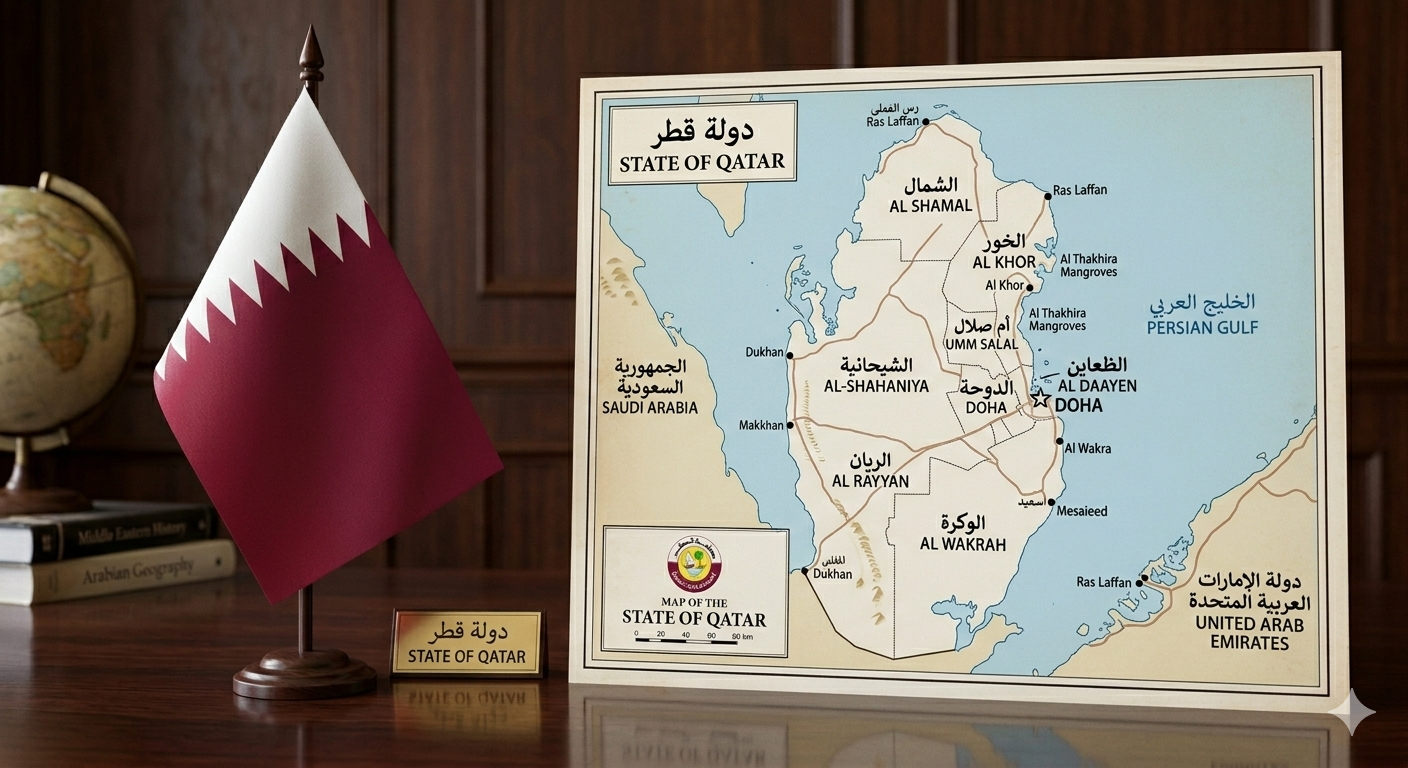
Qatar is a sovereign state located on the northeastern coast of the Arabian Peninsula in Western Asia. It shares its only land border with Saudi Arabia and is surrounded by the Arabian Gulf. Over the past five decades, Qatar has transformed from a modest pearling and fishing economy into one of the world’s wealthiest nations per capita, largely due to its extensive natural gas reserves. Today, Qatar plays an influential role in regional diplomacy, global energy markets, and international development.
Geography and Demographics
Qatar covers approximately 11,571 square kilometers, making it one of the smaller states in the Gulf region. The capital city, Doha, serves as the political, economic, and cultural center of the country.
The population consists of Qatari nationals and a large expatriate workforce, with expatriates forming the majority. Arabic is the official language, and Islam is the state religion. The country maintains a modern urban infrastructure, particularly in Doha and surrounding areas.
Historical Background
The Al Thani family has ruled Qatar since the mid-19th century. In 1916, Qatar became a British protectorate, and it gained full independence on 3 September 1971. Since independence, Qatar has pursued rapid modernization and economic development driven by hydrocarbon revenues.
In 2017, Qatar experienced a regional diplomatic crisis when several neighboring countries imposed a blockade, which was resolved in 2021 through regional reconciliation efforts.
Political System and Government Structure
Qatar is a hereditary constitutional monarchy. The political framework is governed by the Constitution of Qatar, also known as the Permanent Constitution, which came into force in 2005.
The Emir
The Emir is the head of state and holds executive authority. The current ruler, Tamim bin Hamad Al Thani, assumed office in 2013. The Emir appoints the Prime Minister, Council of Ministers, and other key officials. The Emir also represents the state in international relations and serves as Commander-in-Chief of the armed forces.
The Executive Branch
Executive power is exercised by the Council of Ministers, headed by the Prime Minister. The Council implements domestic and foreign policy, drafts legislation, and oversees administrative governance.
The Legislative Branch
Qatar’s legislative authority is vested in the Shura Council (Majlis Al-Shura). The Council consists of members appointed by the Emir, with recent constitutional amendments allowing for partial elections. The Shura Council reviews proposed laws, discusses public policy, and approves the state budget, although final authority rests with the Emir.
The Judiciary
The judiciary is independent under the Constitution. Courts are organized into civil, criminal, and Sharia divisions. The legal system is influenced by Islamic law, particularly in matters of personal status, while civil and commercial laws reflect a combination of Islamic principles and modern legal frameworks.
Economy
Qatar possesses one of the largest natural gas reserves in the world, particularly in the North Field, which it shares with Iran. The country is a major exporter of liquefied natural gas (LNG) and a member of the Organization of the Petroleum Exporting Countries (OPEC).
Economic diversification initiatives under Qatar National Vision 2030 focus on education, finance, tourism, and technology. The state plays a central role in economic planning, supported by sovereign wealth investments through the Qatar Investment Authority.
Foreign Policy
Qatar maintains an active foreign policy centered on mediation, diplomacy, and humanitarian engagement. It is a member of the Gulf Cooperation Council (GCC) and participates in regional and international organizations.
Qatar has hosted major global events, including the 2022 FIFA World Cup, which marked the first time the tournament was held in the Middle East.
Social Development and Infrastructure
Qatar has invested heavily in education and healthcare, including the development of Education City and partnerships with international universities. Infrastructure modernization includes advanced transport systems, smart city planning, and global aviation connectivity through Hamad International Airport.
Conclusion
Qatar represents a modern constitutional monarchy characterized by centralized leadership and strategic global engagement. Its governance framework combines hereditary rule with consultative institutions under the 2004 Constitution. While heavily dependent on hydrocarbon revenues, Qatar continues to pursue economic diversification and international diplomacy to strengthen its long-term sustainability and regional influence.
References
- Government Communications Office – State of Qatar. (n.d.). Official Government Portal.
https://www.gco.gov.qa - Constitution of Qatar. (2004). Permanent Constitution of the State of Qatar.
- World Bank. (2023). Qatar Overview.
https://www.worldbank.org/en/country/qatar - Organization of the Petroleum Exporting Countries (OPEC). (n.d.). Qatar Data.
https://www.opec.org - Gulf Cooperation Council (GCC). (n.d.). Member States.
https://www.gcc-sg.org