The Taj Mahal: History, Architecture and Cultural Significance
Introduction
The Taj Mahal, located in Agra, Uttar Pradesh, India, is one of the most celebrated monuments in the world and a universally recognized symbol of love, architectural brilliance, and Mughal grandeur. Constructed in the seventeenth century by the Mughal emperor Shah Jahan in memory of his wife Mumtaz Mahal, the monument stands on the southern bank of the Yamuna River. It is widely regarded as the finest example of Mughal architecture, a style that combines elements from Persian, Islamic, and Indian architectural traditions. The Taj Mahal is not only a masterpiece of artistic achievement but also an enduring representation of India’s cultural heritage and historical legacy.
Historical Background
The Taj Mahal was commissioned in 1632 by the Mughal Emperor Shah Jahan after the death of his beloved wife, Mumtaz Mahal, who passed away during childbirth in 1631. Deeply grief-stricken, Shah Jahan envisioned a mausoleum that would immortalize her memory. Construction began around 1632 and was substantially completed by 1648, though work on the surrounding buildings and gardens continued until approximately 1653. Historical accounts suggest that thousands of artisans, craftsmen, and laborers were employed in its construction. Materials, including white marble from Makrana in Rajasthan and precious stones from various parts of Asia, were transported over long distances to create this architectural marvel. The chief architect is generally believed to have been Ustad Ahmad Lahauri, though a team of skilled designers and engineers contributed to the project.
Architectural Design and Layout
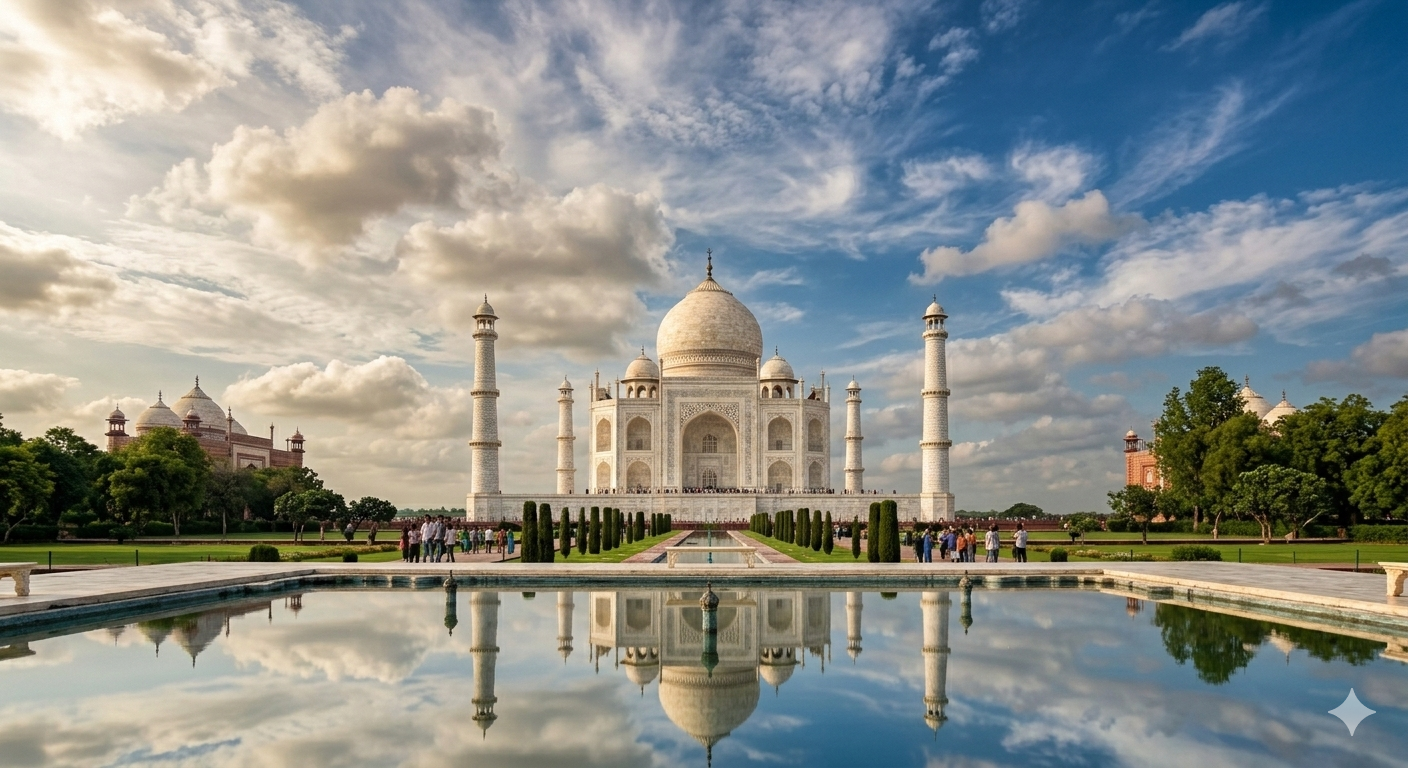
The Taj Mahal complex is laid out in a formal charbagh (four-part) garden style inspired by Persian garden traditions. The main mausoleum stands on a raised marble platform at the northern end of the complex, facing the Yamuna River. The central structure is crowned by a large onion-shaped dome, flanked by four smaller domes and four slender minarets positioned at each corner of the platform. The minarets were slightly tilted outward to protect the main tomb in case of structural failure.
The exterior of the mausoleum is clad entirely in white marble, intricately inlaid with semi-precious stones forming floral and geometric designs, a decorative technique known as pietra dura. Calligraphic inscriptions from the Qur’an adorn the entrance arches, executed with remarkable precision. Inside the central chamber lie the cenotaphs of Mumtaz Mahal and Shah Jahan, while the actual graves are located in a lower chamber according to Islamic tradition. The harmonious proportions, symmetrical layout, and detailed craftsmanship exemplify the height of Mughal architectural achievement.
Cultural and Symbolic Significance
The Taj Mahal holds profound cultural and symbolic significance. It is often described as a monument of eternal love, reflecting Shah Jahan’s devotion to Mumtaz Mahal. Beyond its romantic associations, it represents the zenith of Mughal artistic and architectural innovation. The synthesis of Islamic, Persian, and Indian design elements symbolizes the cultural integration that characterized the Mughal Empire. The monument has influenced architectural developments in India and beyond, becoming a benchmark for aesthetic excellence.
In 1983, the Taj Mahal was inscribed as a UNESCO World Heritage Site, recognized as “the jewel of Muslim art in India and one of the universally admired masterpieces of the world’s heritage.” Its global recognition underscores its importance not only to India but to humanity as a whole.
Conservation and Government Protection
The Taj Mahal is protected and maintained by the Archaeological Survey of India (ASI), which functions under the Ministry of Culture, Government of India. It is designated as a monument of national importance under the Ancient Monuments and Archaeological Sites and Remains Act, 1958. Over the decades, various conservation measures have been implemented to protect the structure from environmental damage, including pollution from nearby industries and vehicular emissions.
The Government of India established the Taj Trapezium Zone (TTZ) in 1996 following a Supreme Court directive to reduce pollution levels in and around Agra. This environmental protection area restricts industrial activities and promotes cleaner fuel usage to preserve the monument’s pristine marble surface. Regular cleaning of the marble using a specialized mud-pack treatment, known as Multani Mitti therapy, has also been undertaken by the ASI to remove pollutants and restore its original sheen.
Tourism and Economic Importance
The Taj Mahal is one of the most visited monuments in India, attracting millions of domestic and international tourists each year. It plays a vital role in the economy of Agra and contributes significantly to India’s tourism revenue. The Government of India and the Uttar Pradesh state government have implemented various measures to improve visitor facilities, regulate crowd management, and enhance security while ensuring the preservation of the site.
Special ticketing arrangements, restricted entry of vehicles near the monument, and the development of infrastructure such as pedestrian pathways and electric buses reflect ongoing efforts to balance tourism with conservation. The monument remains central to India’s cultural diplomacy and international image.
Conclusion
The Taj Mahal stands as an unparalleled testament to human creativity, devotion, and architectural mastery. Its harmonious design, exquisite craftsmanship, and deep emotional resonance continue to captivate visitors from around the world. As a protected monument of national and international significance, it embodies India’s rich historical and cultural heritage. The sustained efforts of the Government of India and heritage authorities ensure that this iconic structure remains preserved for future generations, maintaining its status as one of the greatest architectural achievements in human history.
References
- Archaeological Survey of India (ASI). (n.d.). Taj Mahal – Official Website. Ministry of Culture, Government of India. Retrieved from: https://asi.nic.in
- UNESCO World Heritage Centre. (1983). Taj Mahal – World Heritage List. Retrieved from: https://whc.unesco.org
- Ministry of Culture, Government of India. (n.d.). Ancient Monuments and Archaeological Sites and Remains Act, 1958. Retrieved from: https://indiaculture.gov.in
- Supreme Court of India. (1996). M.C. Mehta vs. Union of India (Taj Trapezium Zone Case). Government of India records.
- Uttar Pradesh Tourism Department. (n.d.). Taj Mahal – Tourism Information. Government of Uttar Pradesh. Retrieved from: https://uptourism.gov.in
Last updated on 04 March 2026 at 01:35 AM.