World Bank: Institutional Overview, Governance and Global Role
Introduction
The World Bank is an international financial institution that provides funding, technical assistance, and policy advice to developing countries for the purpose of reducing poverty and promoting sustainable development. Established in 1944 at the Bretton Woods Conference, the World Bank is headquartered in Washington, D.C., and operates as part of the broader World Bank Group.
The institution plays a central role in global development finance, infrastructure investment, economic reform, climate resilience, and social development initiatives across low- and middle-income countries.
Historical Background
The World Bank was created alongside the International Monetary Fund (IMF) during the United Nations Monetary and Financial Conference in Bretton Woods, New Hampshire, in 1944. It initially focused on post–World War II reconstruction in Europe but gradually shifted its mission toward development assistance in newly independent and emerging economies.
Over time, the World Bank expanded its scope to include poverty reduction, education, health, governance reform, infrastructure development, and climate change mitigation.
Organizational Structure
The World Bank Group consists of five institutions:
- International Bank for Reconstruction and Development (IBRD)
- International Development Association (IDA)
- International Finance Corporation (IFC)
- Multilateral Investment Guarantee Agency (MIGA)
- International Centre for Settlement of Investment Disputes (ICSID)
IBRD provides loans to middle-income and creditworthy low-income countries. IDA offers concessional loans and grants to the world’s poorest nations. IFC supports private sector development, MIGA provides political risk insurance, and ICSID facilitates arbitration of international investment disputes.
Governance and Decision-Making Structure
The governance of the World Bank is based on member-country representation.
Board of Governors
Each member country appoints one Governor, usually the country’s finance minister or central bank governor. The Board of Governors is the highest decision-making body and meets annually to set broad policies.
Board of Executive Directors
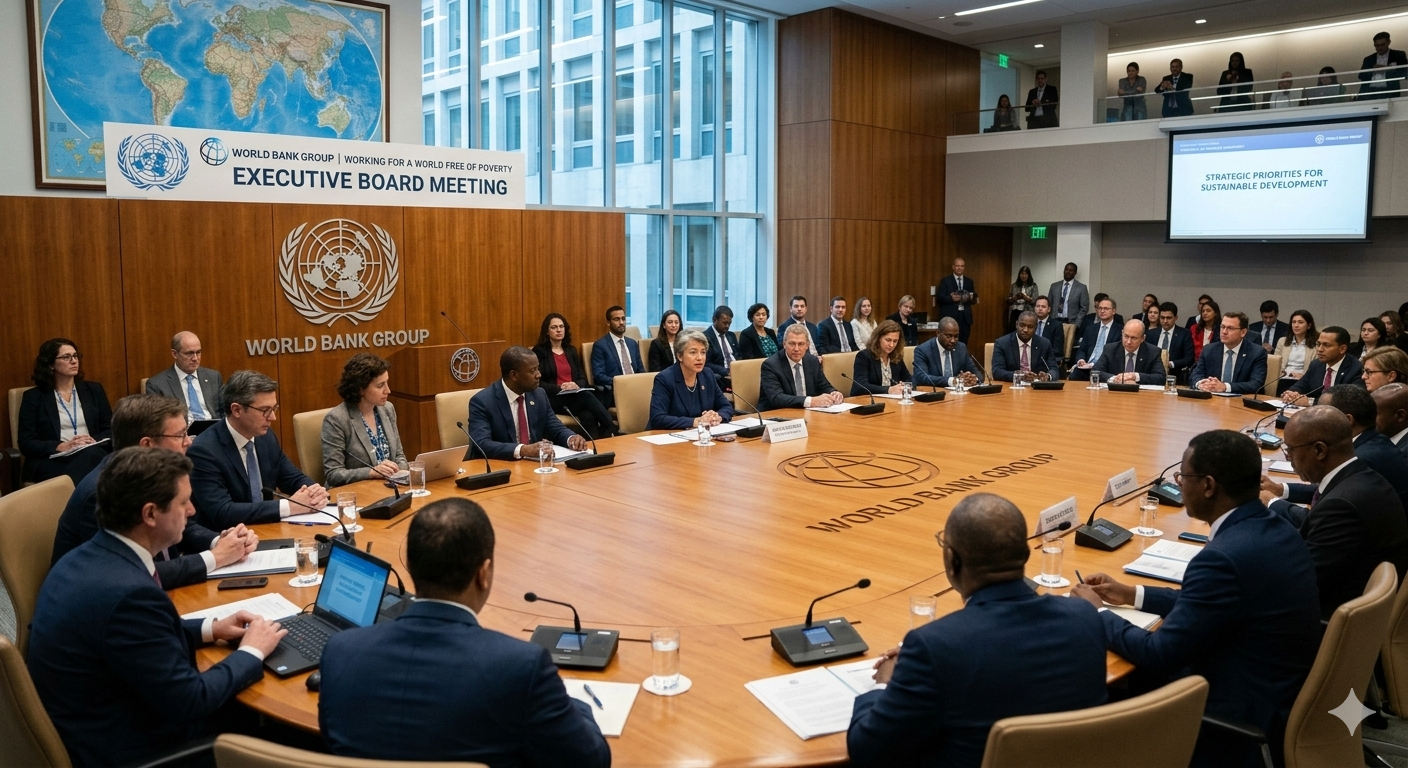
The Board of Executive Directors oversees daily operations. It consists of 25 Executive Directors representing member countries or groups of countries. Voting power is weighted according to financial contributions (capital subscriptions).
President of the World Bank
The President of the World Bank is selected by the Executive Directors and traditionally has been a citizen of the United States. The President oversees overall management, strategic direction, and operations.
Functions and Activities
Development Financing
The World Bank provides loans, grants, and credits to support infrastructure projects, healthcare systems, educational reform, water supply systems, and poverty alleviation programs.
Technical Assistance and Policy Advice
In addition to financial assistance, the institution provides technical expertise, research, and advisory services to governments. It publishes flagship reports such as the World Development Report, which analyzes global development trends.
Poverty Reduction and Sustainable Development
A central objective of the World Bank is to reduce extreme poverty and promote shared prosperity. It supports programs related to gender equality, climate adaptation, food security, and digital transformation.
Relationship with Governments
The World Bank works directly with national governments. Loan agreements are negotiated with borrowing countries, and project implementation typically involves coordination with government ministries and agencies.
While it does not function as a government, its policies and funding decisions influence national economic reforms, fiscal policies, and institutional development strategies in member states.
Criticism and Reform Efforts
The World Bank has faced criticism regarding loan conditionality, environmental impacts of infrastructure projects, and governance representation. Reform discussions often focus on increasing the representation of developing countries in decision-making and strengthening environmental and social safeguards.
Conclusion
The World Bank remains one of the most influential development institutions globally. Through financing, policy advice, and technical expertise, it supports countries in addressing poverty, economic inequality, and sustainability challenges. While debates continue regarding governance reform and lending practices, the institution continues to adapt to global economic and environmental shifts.
References
- World Bank. (n.d.). About the World Bank.
https://www.worldbank.org - World Bank Group. (n.d.). World Bank Group Institutions.
https://www.worldbank.org/en/about - International Monetary Fund (IMF). (n.d.). Bretton Woods History.
https://www.imf.org - Woods, N. (2006). The Globalizers: The IMF, the World Bank, and Their Borrowers. Cornell University Press.
- World Bank. (2023). World Development Report.
https://www.worldbank.org/en/publication/wdr
Last updated on 04 March 2026 at 01:10 PM.