Kuwait: Country Profile and Government Structure
Introduction
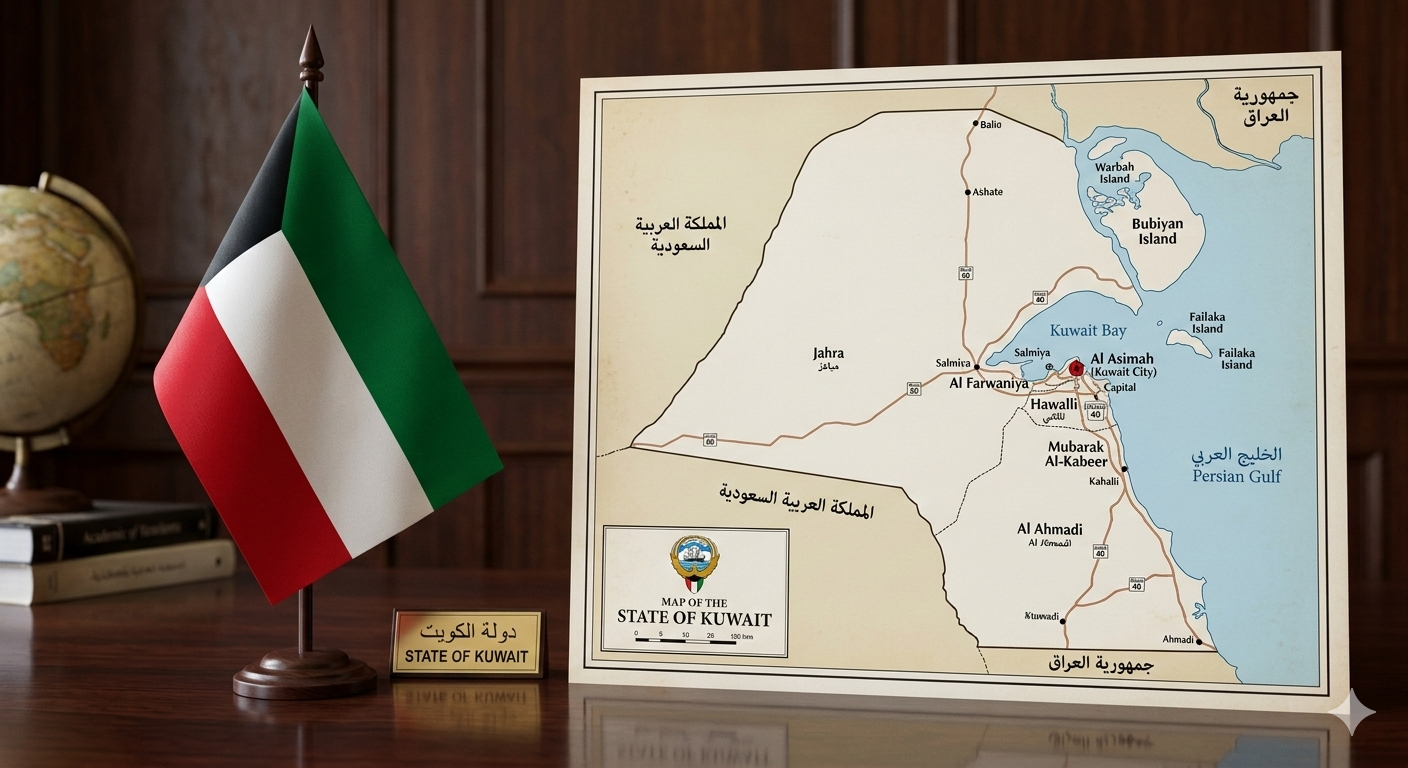
Kuwait is a sovereign Arab state located in Western Asia at the northern edge of the Arabian Gulf. It shares borders with Iraq to the north and west and Saudi Arabia to the south. Known for its significant petroleum reserves, Kuwait plays an important role in regional energy markets and Gulf politics. Since gaining independence in 1961, Kuwait has developed a constitutional system that combines monarchical leadership with an elected legislature.
Geography and Demographics
Kuwait covers approximately 17,818 square kilometers, making it one of the smaller countries in the region. The capital city, Kuwait City, serves as the political, economic, and cultural center.
The country has a diverse population composed of Kuwaiti nationals and a significant expatriate workforce. Arabic is the official language, and Islam is the state religion. The majority of citizens are Sunni Muslims, with a notable Shia minority.
Historical Background
Kuwait emerged as a regional trading hub in the 18th century under the rule of the Al Sabah family. In 1899, Kuwait entered into a protection agreement with the United Kingdom. Full independence was declared on 19 June 1961.
In 1990, Kuwait was invaded by Iraq, leading to the Gulf War. The country was liberated in February 1991 through a U.S.-led international coalition. Post-war reconstruction significantly reshaped Kuwait’s infrastructure and economy.
Political System and Government Structure
Kuwait is a constitutional emirate. The political framework is defined by the Constitution of Kuwait, promulgated in 1962.
The Emir
The head of state is the Emir, a hereditary ruler from the Al Sabah family. The Emir holds executive authority, appoints the Prime Minister, and has the power to dissolve the National Assembly. The Emir also ratifies laws and represents Kuwait in foreign affairs.
The Executive Branch
The Prime Minister heads the Council of Ministers, which functions as the executive authority. Ministers are appointed by the Emir, typically in consultation with political leadership. The Council of Ministers implements policy, proposes legislation, and oversees administrative governance.
The Legislative Branch
Kuwait’s legislature is the National Assembly of Kuwait (Majlis Al-Umma), a unicameral body composed of 50 elected members serving four-year terms. Government ministers may also sit in the Assembly as ex officio members.
The National Assembly holds significant oversight authority, including questioning ministers and initiating votes of no confidence. Compared to other Gulf monarchies, Kuwait’s parliament has relatively strong legislative powers.
The Judiciary
The judiciary operates independently under the Constitution. Courts are structured in several levels, including the Court of Cassation, the Court of Appeal, and Courts of First Instance. Islamic law (Sharia) influences personal status matters, while civil and commercial laws are largely based on a combination of Islamic and European legal traditions.
Economy
Kuwait possesses one of the world’s largest proven oil reserves. Petroleum exports constitute the backbone of the national economy and government revenue. The country is a founding member of the Organization of the Petroleum Exporting Countries (OPEC).
Efforts toward economic diversification have included investment in financial services, infrastructure development, and sovereign wealth management through the Kuwait Investment Authority, one of the world’s oldest sovereign wealth funds.
Foreign Policy
Kuwait maintains a balanced foreign policy emphasizing diplomacy, regional cooperation, and humanitarian assistance. It is a member of the Gulf Cooperation Council (GCC), which promotes economic and security coordination among Gulf states.
The country has also played mediation roles in regional disputes and contributes to international humanitarian initiatives.
Social Development and Infrastructure
Kuwait has invested significantly in education, healthcare, and public services. The government provides extensive welfare benefits to citizens, including housing support and subsidized utilities. Literacy rates are high, and the country maintains modern infrastructure concentrated around urban centers.
Conclusion
Kuwait represents a distinctive model among Gulf states, combining hereditary leadership with an elected parliament that exercises notable legislative oversight. Its political system, shaped by the 1962 Constitution, continues to evolve amid regional and global challenges. While heavily reliant on oil revenues, Kuwait seeks gradual diversification and sustainable development within its constitutional framework.
References
- State of Kuwait. (n.d.). Official Government Portal.
https://e.gov.kw - Constitution of Kuwait. (1962). Government of Kuwait.
- World Bank. (2023). Kuwait Overview.
https://www.worldbank.org/en/country/kuwait - Organization of the Petroleum Exporting Countries (OPEC). (n.d.). Kuwait Facts and Figures.
https://www.opec.org - Gulf Cooperation Council (GCC). (n.d.). Member States.
https://www.gcc-sg.org
Last updated on 03 March 2026 at 7:38 PM.